Reversible plants, the large battery of a renewable Europe
28/03/2025
Share


Reversible plants, the large battery of a renewable Europe
Europe is accelerating the race to find solutions that make a 100% renewable future possible. One of the most efficient and proven ones is reversible hydroelectric plants, also known as pumping plants. But what exactly are they?
The operation is simple: when there is an excess of energy, for example a sunny midday with high solar production, the plants use this energy to pump water to a reservoir located at a higher elevation. When, on the other hand, electricity demand rises or renewable production falls, they release water downstream to turn turbines and generate electricity. In short: they are a kind of giant battery made of water.
A European leadership with a future projection
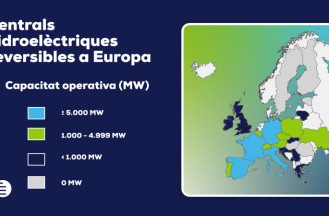
Europe, which already has a long hydroelectric tradition, leads the deployment of this technology. Currently, it has 55,315 MW of power in reversible plants in operation, according to data from Global Energy Monitor. Moreover, there are plans to add more than 20,000 MW in the coming years.
Germany, France, and Spain top this European map. Germany leads the ranking with almost 6,000 MW installed, closely followed by France with 5,042 MW. Spain, for its part, already has 5,479 MW in operation and is preparing for ambitious growth with nearly 3,000 MW new, some already under construction.
Other countries with significant involvement in this technology include Italy (7,563 MW), Austria (4,547 MW), and Switzerland (3,679 MW). Although having a smaller capacity, the United Kingdom is ramping up and plans to build an additional 6,350 MW.
There are also significant movements in Portugal, Poland, Belgium, or Greece, and countries like Romania, Ukraine, or Serbia are starting to bet strongly on this system.
Catalonia also wants to join the transition
In Catalonia, the energy roadmap PROENCAT 2050 clearly supports reversible plants. Currently, in our country, there are 534 MW installed, but it is expected to reach 3,734 MW in 25 years. Overall, the goal is to leverage existing infrastructures and minimize environmental impact, without building new large reservoirs.
In addition to pumping plants, Catalonia has great potential in other renewable energies. According to the PROENCAT 2050, the renewable sources that will shape Catalonia’s energy future are mainly solar photovoltaic energy, onshore and offshore wind energy, hydraulic power (with regulating and flowing water plants), biomass, biogas, and the recovery of renewable waste.
Pumping plants are, therefore, a key piece to advance towards a 100% renewable Europe. They help address one of the major challenges of the energy transition: ensuring clean electricity when the sun and wind do not provide enough. Ultimately, they turn water into an indispensable ally to realize the sustainable future that the continent seeks.